← Breath-by-Breath Tab · Home · Clinical Report →
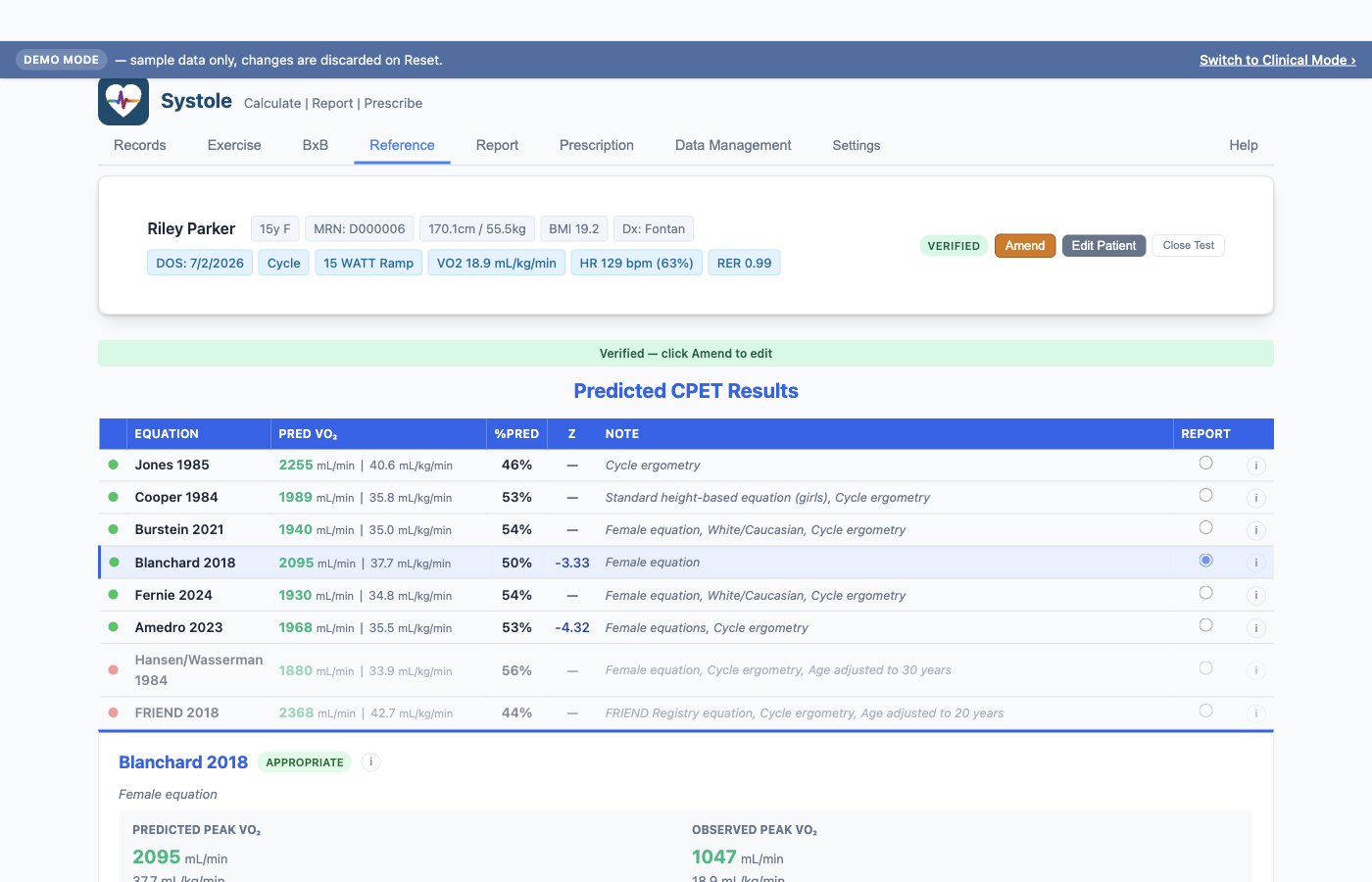
The Reference tab displays predicted CPET values from 8 validated normative equations. Predictions calculate automatically whenever patient demographics and observed CPET data are available.
Demographics have to be plausible, not just present. Systole computes nothing at all unless age is 6–100 years, height 100–250 cm, weight 15–300 kg, and sex is Male or Female. Outside those bounds the Reference tab, the Report tab and the trend charts show no predictions rather than eight implausible ones — a height typed in inches instead of centimetres (64 rather than 163) used to return negative predicted values marked "appropriate". If the table is unexpectedly empty, check the test's height, weight, age and sex first. Note that this also means no equation is offered for a patient under 6, because none is validated there.
| Equation | Age Range | Modality | Population | Z-Score |
|---|---|---|---|---|
| Jones (1985) | 15–71 | Cycle | General adult | No |
| Hansen/Wasserman (1984) | ≥18 | Cycle & Treadmill | Adult, weight-class adjusted | No |
| Cooper (1984) | <18 | Cycle & Treadmill | Pediatric, height/BMI variants | No |
| FRIEND (2018) | 20–85 | Cycle & Treadmill | Large adult registry | No |
| Burstein (2021) | 6–18 | Cycle | Pediatric, race-specific (White/Black/Hispanic) | No |
| Blanchard (2018) | 12–18 | Cycle | Pediatric, BMI-corrected | Yes |
| Fernie (2024) | 6–18 | Cycle & Treadmill | Pediatric, ethnicity-adjusted | No |
| Amedro (2023) | 6–18 | Cycle | International pediatric registry | Yes |
All 8 equations are displayed in a single table, sorted by status (green first, then yellow, then red). Each row shows:
| Color | Meaning | Example |
|---|---|---|
| Green | Appropriate — patient within validated population | 14-year-old on cycle → Blanchard is green |
| Yellow | Caution — near edge of range or adjustment applied | Treadmill with cycle-based equation |
| Red | Not appropriate — outside validated population | 8-year-old with adult equation (Jones) |
Equations with age outside their validated range have their age capped to the range boundary for calculation (e.g., Fernie caps at 18 for adults) and show an adjustment note.
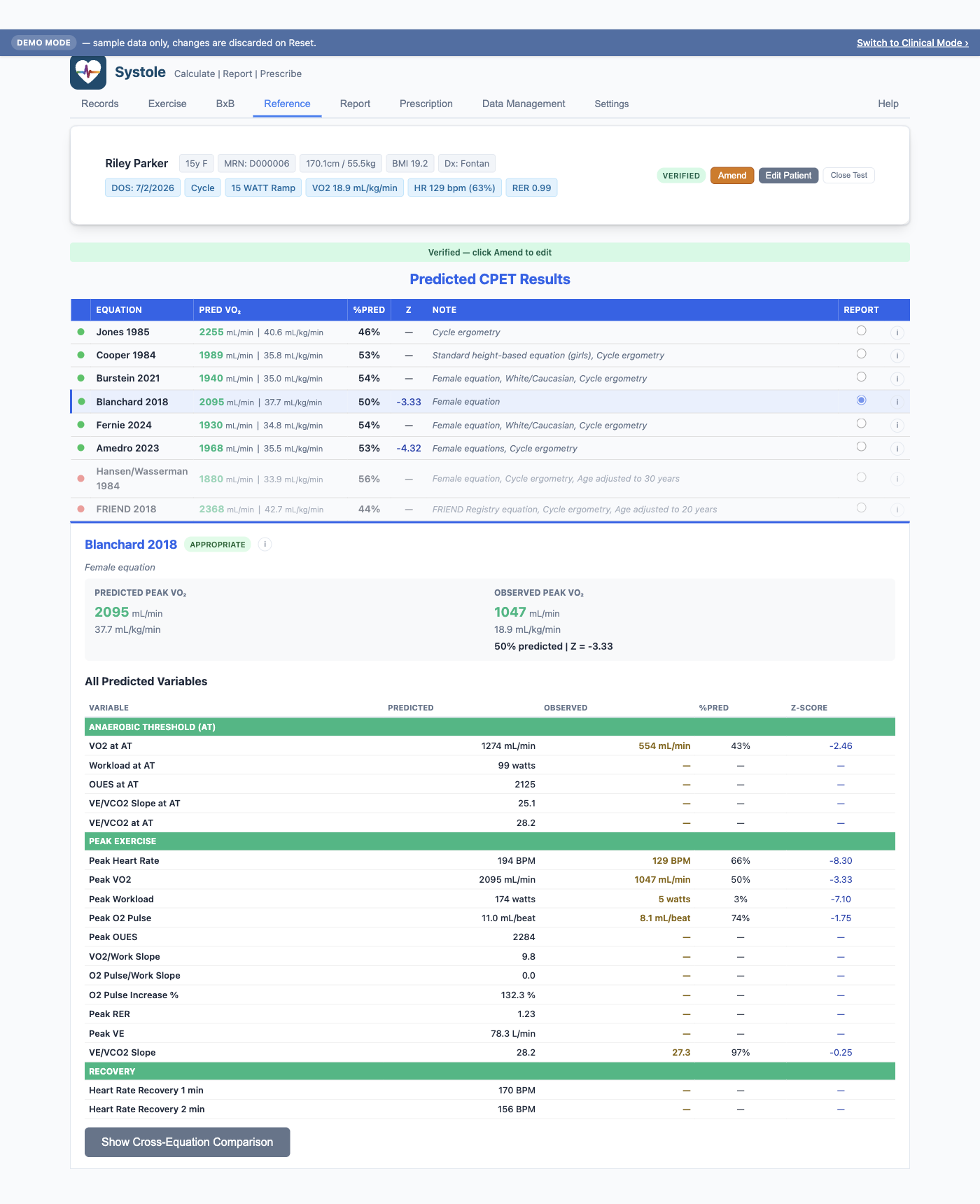
Click any row to expand the full detail panel below the table (the previously expanded row collapses):
Select the Report radio button on the equation row you want to use as the normative reference. This selection:
If no equation is explicitly selected, Systole uses the site default configured in Settings (shown as "site default" in the Report tab header). The site default is resolved at display time, so changing the default in Settings immediately affects all preliminary or amended tests that don't have an explicit selection.
Verification locks the reference in. When you click Verify on a test that was using a resolved default (no explicit click on a Report radio), Systole snapshots the currently-resolved equation name into the test record at that moment. The verified test's impression will continue to render against the snapshotted equation forever, even if you later change the site default — preventing the verified clinical interpretation from drifting silently.
Pediatric patients (cycle ergometry):
Pediatric patients (treadmill):
Adult patients:
Click Show Cross-Equation Comparison in the detail panel to view predicted values from all multi-variable datasets (Burstein, Blanchard, Fernie, Amedro) side by side. Click dataset column headers to expand comparison columns showing predicted values, Z-scores, and percent predicted. Reset Table clears column expansion state.